Most people walk out of Shutter Island thinking they missed something. They didn’t. The film gave them everything. They just received it through the wrong pair of eyes.
The entire story runs on a single, devastating premise: the investigator is the patient. Teddy Daniels is not a U.S. Marshal. He is Andrew Laeddis, a long-term resident of Ashecliffe Hospital who built a fictional identity so convincing it fooled him completely.
Once that lands, the ending stops being a twist and starts being a diagnosis. Every scene before it was a symptom.
So what does the ending actually confirm? Not just who Andrew is. It confirms something far more uncomfortable: that knowing the truth and being free of it are two completely different things.
The Person Teddy Daniels Was Never Real
How the Marshal Identity Was Constructed
Andrew didn’t randomly invent a character. He built Teddy Daniels with internal logic, emotional scaffolding, and a mission that gave his fractured mind something to hold onto.
The Marshal identity offered exactly what Andrew’s real life had destroyed: purpose, moral authority, and an external enemy to chase. Guilt is unbearable when it points inward. Teddy’s entire existence was a system for pointing it outward.
This is why his investigation felt so urgent and real. The conspiracy theory about Ashecliffe, the missing patient, the lighthouse full of horrors.
None of it was random paranoia. Every element protected him from one specific memory: his wife Dolores killing their children, and his failure to see it coming.

The Clues That Were Always There
The film plants its evidence carefully and without apology. A second viewing turns the movie into a completely different experience.
Watch how the staff behaves around “Marshal Daniels.” Guards treat him with controlled tolerance, not institutional deference. Patients pause mid-sentence when he approaches, as if measuring words.
One woman makes a clear silencing gesture in his direction. These aren’t continuity errors. They’re people navigating around a patient who believes he is in charge.
His recurring dreams do the same work. Water imagery runs through every nightmare because his children drowned.
Fire appears repeatedly because Dolores, and the destruction she caused, is the wound his mind keeps circling. These weren’t symbolic flourishes. They were suppressed memories bleeding through the fiction.
What the Lighthouse Was Actually Hiding
The Conspiracy Teddy Expected to Find
Teddy was convinced the lighthouse concealed illegal psychiatric experiments. He believed it held evidence of mind control, violence, and institutional corruption. That belief kept him moving through the film with urgency and righteous purpose.
It also kept him from looking at himself.
A conspiracy requires an external villain. As long as the lighthouse held monsters, Andrew Laeddis didn’t have to. The threat was always something out there, never something in the mirror.
What Was Actually Inside
The lighthouse contained medical records and clinical documentation, not torture chambers. Dr. Cawley delivered the truth there plainly and without theater. No coercion, no dramatic confrontation staged for effect. Just a doctor telling a patient who he was and what he had done.
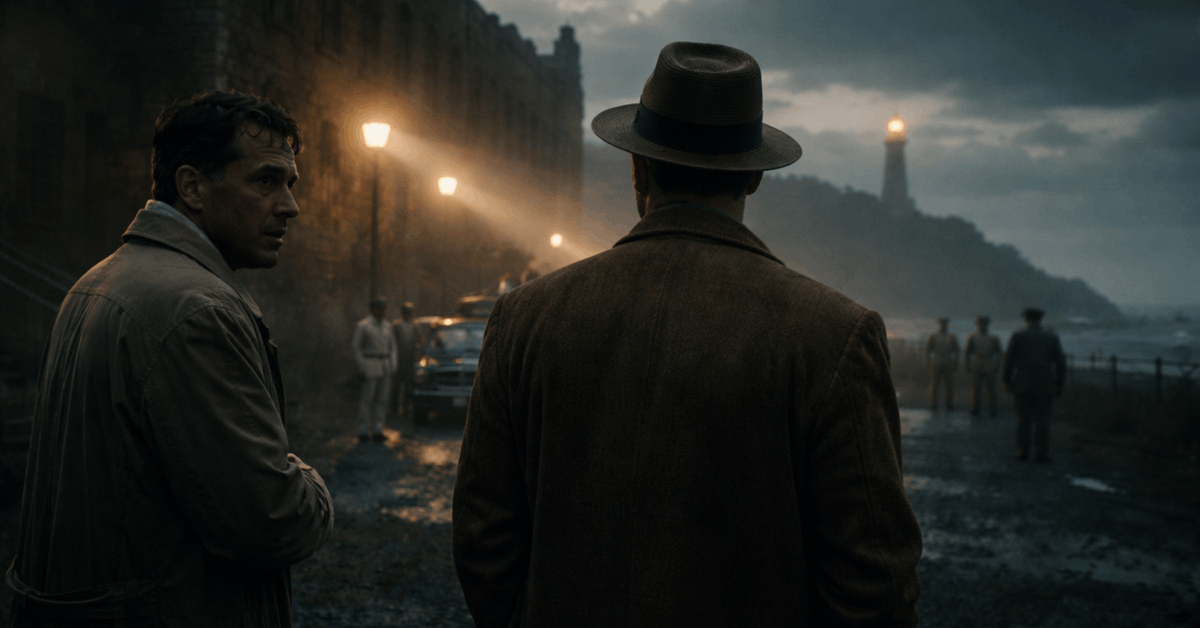
The lighthouse, it turns out, is the film’s symbol for confrontation itself. Teddy feared it precisely because some part of him knew what lived inside. Not a government secret. His own history.
Also read: Why The Leftovers Finale Hits Harder Once You Stop Hunting for Answers
The Therapeutic Experiment and Its Ethical Edge
Dr. Cawley’s Professional Gamble
Dr. Cawley built the role-play experiment on a conviction most of his colleagues didn’t share: that Andrew could reach awareness if given the right conditions to arrive there himself.
His gamble was significant. The hospital staged an entire investigation, cast staff members as supporting characters, and let a patient’s delusion run for as long as it needed to.
The goal was to walk Andrew to the truth from inside his own fiction rather than force it on him from outside.
That approach reflects a genuine tension in psychiatric care. Confronting delusional identity directly often triggers deeper resistance. Working from within the patient’s frame, as Cawley attempted, is riskier and slower. But for someone as entrenched as Andrew, the conventional path had already failed.
Cawley’s failure wasn’t ethical or procedural. It was emotional. He got Andrew to the door of awareness. He couldn’t make him stay.
Dr. Sheehan’s Harder Role
Dr. Sheehan carried the most personal weight in this experiment. Playing “Chuck” required him to build genuine trust with a patient who needed to believe in the partnership completely.
His visible grief in the final scene isn’t professional disappointment. It’s the response of someone who watched a person he’d grown close to make a choice that couldn’t be reversed.
Whether Andrew chose the lobotomy deliberately or relapsed into delusion, Sheehan’s expression signals the same thing: this outcome was not the one he wanted.
Why Andrew’s Final Line Is the Whole Film in One Sentence
The Question That Requires Self-Awareness to Ask
“Is it better to live as a monster or die as a good man?”
That question cannot come from a mind in full delusional collapse. A man who genuinely believes he is Marshal Teddy Daniels doesn’t frame his situation in those terms. He doesn’t position himself as a monster. He positions himself as a victim of institutional conspiracy.
The phrasing confirms awareness. Andrew understands, in that moment, exactly who he is and what he did. He is not confused about his identity. He is weighing what to do with it.
Here is what makes this the most unsettling moment in the film:
- He asks the question calmly, without panic or resistance
- He directs it at Dr. Sheehan, the one person who knows what it costs to answer honestly
- He frames guilt as something he might escape, not something he might survive
- He walks toward the orderlies without hesitation after the question lands
None of that behavior belongs to a man in relapse. It belongs to a man who has made a calculation.
A Conscious Exit, Framed as Tragedy
My take on this, and I’ll be direct about it: most film analysis treats the faking-the-relapse reading as a clever observation, but I think it’s the only reading the final scene actually supports.
The calm delivery, the philosophical framing, the absence of any resistance, these are specific details from specific moments in that closing sequence. Coincidences don’t stack like that.
Andrew chose the lobotomy because living with awareness was worse than losing awareness entirely. He decided that dying as a good man, even a fictional one, was more bearable than spending the rest of his life as the person who let those children die.
That’s not a weakness. It’s a rational response to unbearable pain. The film frames it as tragic, not cowardly, and that distinction matters.
What the Ending Confirms About Truth and Healing
Knowing the Truth Is Not the Same as Being Free of It
This is where Shutter Island pushes past standard thriller territory into something genuinely uncomfortable.
Andrew reaches awareness. The experiment works, technically. Dr. Cawley’s method produced the result it was designed to produce. And then Andrew decides he doesn’t want what awareness costs.
The film rejects the therapeutic assumption that truth is inherently liberating. Knowing what happened to his children didn’t repair Andrew’s mind.
It handed him a weight he had spent years building an entire identity to avoid carrying. Clarity arrived and immediately revealed why the delusion existed in the first place.
The Choice Itself Is the Point
Andrew’s decision reframes every earlier scene as a prologue to a single moment of agency. He wasn’t passive. He wasn’t swept along by illness. He made a choice, possibly the last fully conscious one available to him, and he made it with his eyes open.
The film closes on that choice without judgment. Scorsese doesn’t tell you how to feel about it. He just confirms that it happened, and then lets you sit with the implications.
Questions People Ask About Shutter Island’s Ending
Q: Was the investigation ever a real assignment?
No. The entire investigation was staged by Ashecliffe hospital staff. Dr. Sheehan played Chuck, and every aspect of the role-play was designed to walk Andrew through his own delusion until he confronted the truth underneath it.
Q: Did Andrew kill his wife Dolores?
No. Dolores killed their three children. Andrew, struggling with his own trauma and her deteriorating mental state, failed to stop it. His guilt centers on that failure, not on any direct violence he committed.
Q: Why did the other patients act strangely around Teddy?
They were navigating around a patient who believed he was their authority figure. Some were coached on how to behave. Others simply reacted to the dissonance of seeing a fellow patient acting as a law enforcement officer.
Q: Could the lobotomy be reversed or prevented at that point?
Once the hospital staff interpreted Andrew’s behavior as a final relapse, or accepted his apparent decision to regress, the procedure moved forward. Dr. Cawley’s experiment was the last attempt to avoid it. Its failure, real or performed, closed that option.
Q: Is there a version of the story where Andrew recovers?
The film implies he came close more than once. But sustained recovery from dissociation at that depth requires the patient to choose engagement with reality repeatedly, not just once. Andrew’s guilt made that ongoing choice feel worse than the alternative.
Conclusion
Shutter Island’s ending confirms what the film spent two hours carefully building toward: Andrew Laeddis understood exactly who he was in those final moments.
His last question was not confusion speaking but clarity arriving at a terrible conclusion. The tragedy isn’t that the truth was hidden from him.
The tragedy is that truth found him, and he decided oblivion was the better offer. What the film leaves behind is a question it refuses to answer for you: would you have chosen differently?