Spoiler warning: Tenet gets easier when you stop mapping every event at once. It follows one connected timeline with people moving in opposite temporal directions.
Its key ideas are inversion, consequence, and choice, not alternate universes. This guide follows the rules, motives, and final mission.
Start With Inversion, Not Time Travel
Tenet uses a strange rule but remains in one world. Reversed entropy changes movement, while fixed events keep consequences connected.
Inversion Means Moving Backward Through the Same World
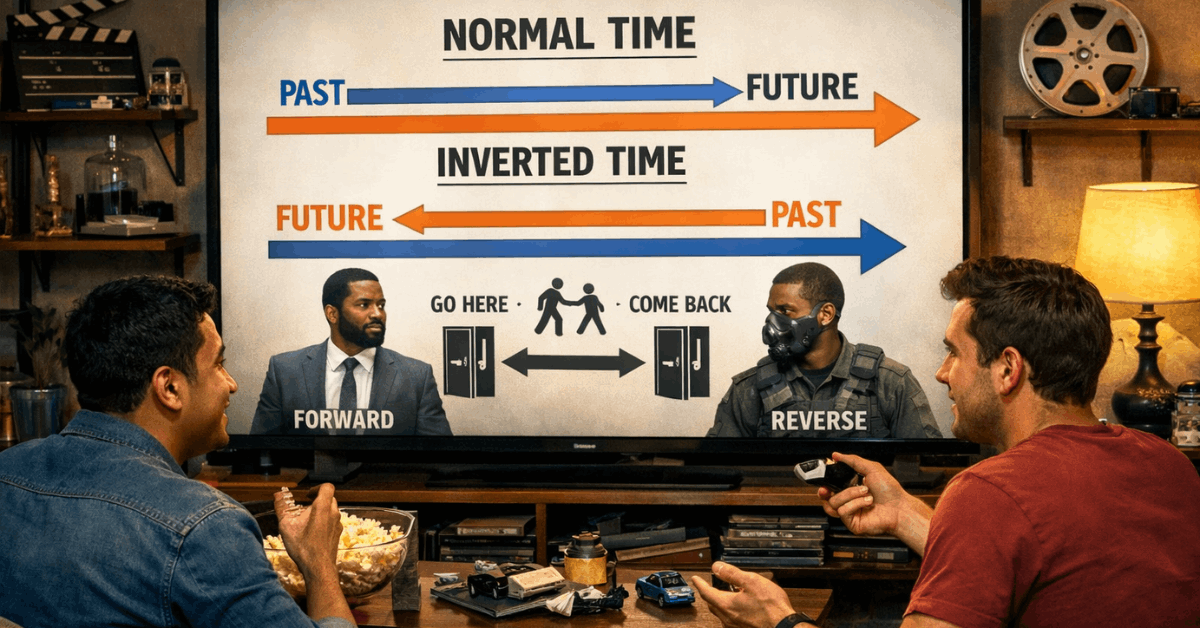
Inversion does not send people to a separate past with unlimited changes. An inverted person travels backward relative to others, experiencing air, fire, and motion differently.
That is why the film shows bullets returning and damaged objects repairing, even while the world moves forward. The official Tenet page presents the mission as a fight for survival, not branching realities.
One Moment Can Be Seen From Two Directions
The film shows an event forward, then returns after a character inverts. It supplies the missing half, not a rewrite.
This creates two perspectives and one completed event, the clearest way to approach scenes that initially feel impossible. Ask who is moving forward, who is inverted, and what each person knows.
The Future Uses Sator to Threaten the Present
Inversion becomes dangerous when people weaponize it. Future desperation and Sator’s resentment make it a larger threat.
Sator Collects the Algorithm for a Future Plan
People in the future believe their damaged world can be saved by reversing the present world’s entropy, even if that destroys everyone living now.
They send instructions and inverted materials to Andrei Sator, who collects pieces of the Algorithm for them.
This makes him a human intermediary and a global danger, not a villain who simply enjoys confusing technology. His plan is to bury the completed Algorithm where a nuclear explosion can hide it.
Also read: Movie Timeline Explained From Start to End
Kat Gives the Mission a Personal Cost
Kat begins by trying to escape Sator’s control while protecting her son. Her fear, anger, and patience keep the story from becoming only a technical mission about objects and physics.
She represents personal freedom and emotional stakes, because stopping Sator also ends the life he built around intimidation.
When Kat acts on the yacht, her decision becomes part of the larger timing, not a separate revenge plot.
The Set Pieces Teach the Film’s Rules
Tenet rarely pauses to lecture after each concept. It uses action scenes and repeated events before explaining their meaning.
The Freeport Fight Reveals the Second Half
At the Oslo Freeport, the Protagonist fights a masked attacker who seems to move in impossible ways. Later, he learns that the attacker is his inverted self crossing the moment from the opposite direction.
The scene is not random choreography and not a duplicate universe; it is one person meeting another point on his own path. Once clear, it becomes a compact lesson in how Tenet hides context in plain sight.
The Highway Chase Shows Missing Context
The highway sequence feels chaotic because cars, people, and objects move through time differently. In the first version, the Protagonist sees effects without understanding their causes.
After he inverts, the sequence becomes easier to read because he experiences the other side. The chase teaches reversed cause and effect and environmental clues, including unusual fire, reversed motion, and the need for oxygen.
Neil and the Protagonist Carry the Emotional Loop
The final mission connects strategy with a friendship each man experiences differently. Delayed understanding and reversed friendship give it emotional weight.
The Protagonist Learns He Creates Tenet
By the ending, the Protagonist understands he will establish Tenet and set earlier parts of the operation in motion.
His mission has been guided by a future version of himself, even while his present self learns the rules in pieces.
This gives him future responsibility and present uncertainty, rather than making him a hero who understands every move. He must protect the world without seeing the whole design until it is nearly complete.
Neil Finishes a Friendship Already Underway
Neil knows the Protagonist from a future period the Protagonist has not reached. At Stalsk-12, Neil returns through inversion to open the gate and take the fatal shot that lets the others finish the operation.
His choice carries calm acceptance and quiet sacrifice, because the friendship is ending for him as it begins for the Protagonist.
The official Netflix synopsis frames the mission around stopping an oligarch using future inversion technology for a global catastrophe.
Follow Three Markers During a Rewatch
A rewatch does not require solving every question before the next scene. Watch direction, knowledge, and motivation when action becomes dense.
Notice the Practical Signals First
Identify whether a character has passed through a turnstile, whether the scene is moving forward or backward, and what information is missing.
This keeps the film grounded in visible evidence and simple questions instead of fan theories. Use this short guide while watching:
- Direction: Track who is forward and who is inverted.
- Knowledge: Separate what a character knows from what viewers know.
- Motivation: Remember why stopping Sator matters to Kat, Neil, and the Protagonist.
Let Character Choices Explain the Mechanics
Tenet clears up when its science meets character choices. Sator uses knowledge to control, Kat reclaims agency, Neil accepts a cost, and the Protagonist protects a future he builds.
These patterns reveal human stakes and moral consequences before every technical detail becomes certain. The film asks viewers to follow purpose alongside mechanism, not choose one over the other.
Conclusion: The Loop Works Because the Choices Matter
Tenet is a story about one connected loop, not a collection of alternate timelines. Inversion changes direction, but it does not erase consequence; the Freeport fight, highway chase, and final mission show events completed from both sides.
Neil’s sacrifice and Kat’s escape make the global threat personal, while the Protagonist’s future role explains why the mission was possible.
Watch direction, then motivation, and difficult scenes become clues across the film’s shifting set pieces.