Drogon melts the Iron Throne in the final minutes of Game of Thrones, and that one image explains every character ending better than eight seasons of dialogue combined.
Most recap guides list survivors in bullet points and stop there. This one maps the why behind each fate, because the endings only land when you see the pattern connecting them.
Game of Thrones characters reach conclusions tied directly to what they learned, or refused to learn, across the series. The Starks scatter. The Lannisters fracture. The throne literally disappears.
So here is the full map: who lives, who dies, and what the realm looks like when the credits roll.
The Stark Family Got Four Completely Different Endings
Eight seasons of war, betrayal, and grief, and the Starks end up scattered across the continent. No reunions, no crowns shared, no family seat restored. Each one closes their arc in a place that fits exactly who they became.
Jon Snow Chose Exile Over a Crown
After killing Daenerys inside the Red Keep, Jon accepts a sentence to the Night’s Watch. But he does not stay at Castle Black. He rides north beyond the Wall with Tormund and Ghost, helping the Free Folk resettle in open land.
I think this ending is more earned than fans give it credit for. Jon spends eight seasons being pushed into leadership he never wanted, and riding into the open north with Ghost is the first decision that feels entirely his own.
His arc closes on freedom through exile, which sounds like a contradiction until you remember that every crown offered to Jon eventually cost someone else their life.
Sansa Stark Becomes Queen in the North
Independence becomes policy when Northern lords acclaim Sansa as Queen in the North. She does not ask for the title.
She earns it through grain stores, loyal bannermen, and a hard lesson absorbed in King’s Landing: the North bleeds every time it trusts southern politics.
Sansa’s ending is the most straightforward win in the finale. She started as a pawn and finished as the only Stark ruling from a seat of actual power.
Arya Sails West Instead of Going Home
A life built on lists and kills turns outward. Arya refuses Gendry’s marriage proposal, sails west of Westeros on a Stark ship, and trades vengeance for exploration.
The Faceless Men training, the assassin years, every name on the list. All of it stops being about revenge and becomes a skill set for something completely new.
She sails toward uncharted territory, which is either the boldest ending or the most anticlimactic depending on how much you needed her to finish the list.
Bran Becomes King, and the Show Was Building Toward It
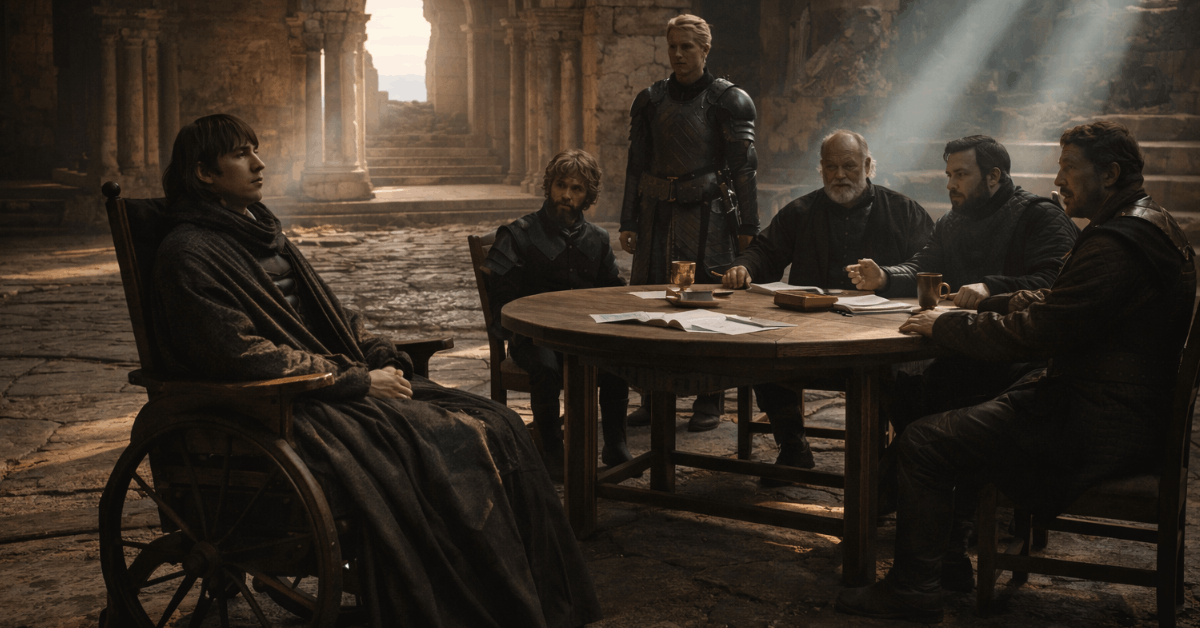
Lords elect Bran the Broken as King of the Six Kingdoms. He does not campaign for it. He barely reacts to it. His detachment, his sight, and his complete lack of personal ambition are exactly why the lords choose him after watching charismatic rulers burn cities for eight seasons.
I find Bran’s election the most logically consistent choice in the finale. The show builds one argument across eight seasons: rulers who want power are the most dangerous ones to give it to.
Bran is the first candidate in the entire series who genuinely does not want the throne. That is the point.
The council structure around him reinforces it. Bronn handles coin, Sam oversees records, Davos manages ships. Governance runs through competence rather than bloodline.

The Deaths That Reshaped the Final Season’s Board
Several deaths earlier in the series did more work than the finale itself. Understanding them explains why the final board looks the way it does.
Daenerys Targaryen: Power Without Restraint
After burning King’s Landing, Daenerys dies in the throne room when Jon chooses duty over love. Drogon carries her body east, ending the Targaryen restoration in the capital and creating the vacuum that forces the election of a new king.
Her fall is the show’s central thesis made literal. The woman who spent years promising liberation becomes the thing she swore to destroy.
Cersei and Jaime Go Out Together
Reunited beneath the Red Keep, both die under collapsing stone. Lannister family fate shifts from dominance to memory in a single scene, clearing space for postwar lords who favor process over dynasty.
Cersei’s end is quieter than her character deserved. But the collapse is fitting. She spent the entire series building walls that eventually buried her.
The Earlier Deaths That Set the Whole Board
A few deaths from Seasons 1 through 6 echo loudest through the finale:
- The Night King falls at Winterfell when Arya strikes, turning the living’s energy back toward politics and strengthening Sansa’s independence case at the great council
- Petyr Baelish is executed after Arya and Sansa expose his crimes, removing the last inside agitator pushing the Stark siblings against each other
- The High Sparrow and the Sept of Baelor go up in wildfire, removing the theocratic bloc and most Tyrell influence in a single strike
- Ramsay Bolton dies at Winterfell, restoring the Stark banner and unlocking the North’s resolve that carries into the final season
Each loss compressed the political board and removed one more reason for the Starks to stay divided.
Also read: The Leftovers Finale Explained for Viewers Who Felt Cheated by “The Book of Nora”
Everyone Else Who Made It Out Alive
The survivors after Season 8 extend well beyond the main Stark arcs. Several characters who entered in early seasons reach the credits with clear fates.
| Character | Starting Point | Final Role |
|---|---|---|
| Tyrion Lannister | Sentenced to death, twice | Hand to King Bran |
| Brienne of Tarth | Sworn to protect the Starks | Lord Commander of the Kingsguard |
| Samwell Tarly | Scared steward at Castle Black | Grand Maester |
| Bronn | Sellsword in King’s Landing | Master of Coin, Lord of Highgarden |
| Grey Worm | Slave soldier | Sailed to Naath with the Unsullied |
| Gendry Baratheon | Blacksmith’s bastard | Lord of Storm’s End |
| Yara Greyjoy | Theon’s captured sister | Queen of the Iron Islands |
Most of these endings reward characters who attached themselves to something larger than personal survival. Tyrion shifts from cleverness for survival to service for repair. Sam wins because study matters more than swords in peacetime.
Grey Worm escorts the Unsullied to Naath to honor Missandei’s memory as a living promise.
That detail gets overlooked in most recaps, but it is one of the finale’s quietest and most complete character closures.
For full episode summaries and cast information, HBO’s official Game of Thrones page has the complete series archive.
The Season 1 Faces Who Quietly Outlasted Everyone
A few background characters from the pilot survive every regime shift:
- Bronn enters as a sellsword with precise instincts and exits holding Highgarden and the treasury, which is arguably the most successful career arc in the entire show
- Samwell Tarly starts as a terrified steward at the Wall and ends as Grand Maester, the realm’s chief scholar and record-keeper
- Robin Arryn matures enough to cast a steady vote for Bran, proving sheltered nobles can still adapt when the wars stop
- Podrick Payne outlasts nearly every lord he ever served, ending near Tyrion and Brienne as a quiet court companion whose loyalty never wavered
What the Realm Looks Like After the Final Episode
Postwar Westeros trades single-family rule for a looser compact. A king elected by lords, an independent North, and a Hand who values negotiation push the realm toward smaller, steadier decisions.
The Iron Throne does not just lose its occupant. Drogon melts the entire thing. Kingship shifts from bloodline to vote, from iron to consensus.
The council’s mix of Bronn, Davos, Brienne, and Sam signals a clear preference for competence over lineage. These are people who survived because they were useful, not because they were born into the right house.
Jon’s passage north also functions as a pressure valve. His Targaryen blood, if he stayed south, would have kept vengeance and succession arguments on the table indefinitely. Sending him beyond the Wall removes that tension without executing him.
Wondering where the Targaryens started before all of this collapsed? House of the Dragon on HBO is set nearly 200 years earlier and shows the family at the height of its power. No survivor from the Game of Thrones finale appears, but the context makes the fall hit harder.
Questions People Ask About the Game of Thrones Finale
Q: Did Tyrion survive the Game of Thrones finale? Yes. Tyrion lives and serves as Hand to Bran. His survival feels unearned to some viewers given his imprisonment, but the show frames it as the cost of Daenerys losing her last check on power.
Q: What happened to Drogon after Daenerys died? Drogon flew east carrying her body. Nobody knows where he went. Bran’s first act as king is to search for Drogon’s location, which means the question stays open even inside the story’s own canon.
Q: Is the Iron Throne destroyed at the end of the show? Yes. Drogon melts it after Daenerys dies, and the show treats this as the clearest possible symbol. Kingship moves from inheritance to election, and the physical throne ceases to exist.
Q: Why was Bran chosen as king over Sansa or anyone with a stronger claim? The lords needed someone with no dynastic ambition, no living heirs to fight over, and no personal scores to settle. Bran fit all three. Sansa pushed for Northern independence rather than the larger crown, and she got exactly that.
Q: Did a Game of Thrones spin-off about Jon Snow ever happen? A follow-up series entered early development and then stopped. Arya’s westward voyage also gets frequent fan requests, but no active production has been confirmed. The endings described in the finale stand as the final screen canon.
Conclusion
Drogon did not burn the Iron Throne by accident, and every character’s ending connects directly to how each person handled power. Jon rides north because reaching for a crown he never wanted kept costing people around him their lives.
Sansa rules the North because she stopped trusting systems she could not personally control or predict.
The realm lands in imperfect hands, spread across a small council of competent survivors, which is the most honest ending a show about power could offer.