Most science fiction treats physics like a speed bump. The Expanse treats it like a character. Every tactical choice, political crisis, and cultural habit in the series traces back to one thing: cost.
This is a teardown, not a fan letter. I want to show you exactly which mechanisms make this setting feel real, and where those same mechanisms crack under the weight of long-form storytelling.
The audience here is not the casual viewer who just finished a season. It is the writer or worldbuilder who watched The Expanse and thought: “How did they make me care about orbital mechanics?”
The Expanse worldbuilding earns trust through a single discipline. Technology carries a visible price. Once you see how that works, you cannot unsee it in anything you read or write.
The One Rule That Makes The Expanse Feel Real
Every major technology in this universe comes with a cost that shapes what characters can and cannot do.
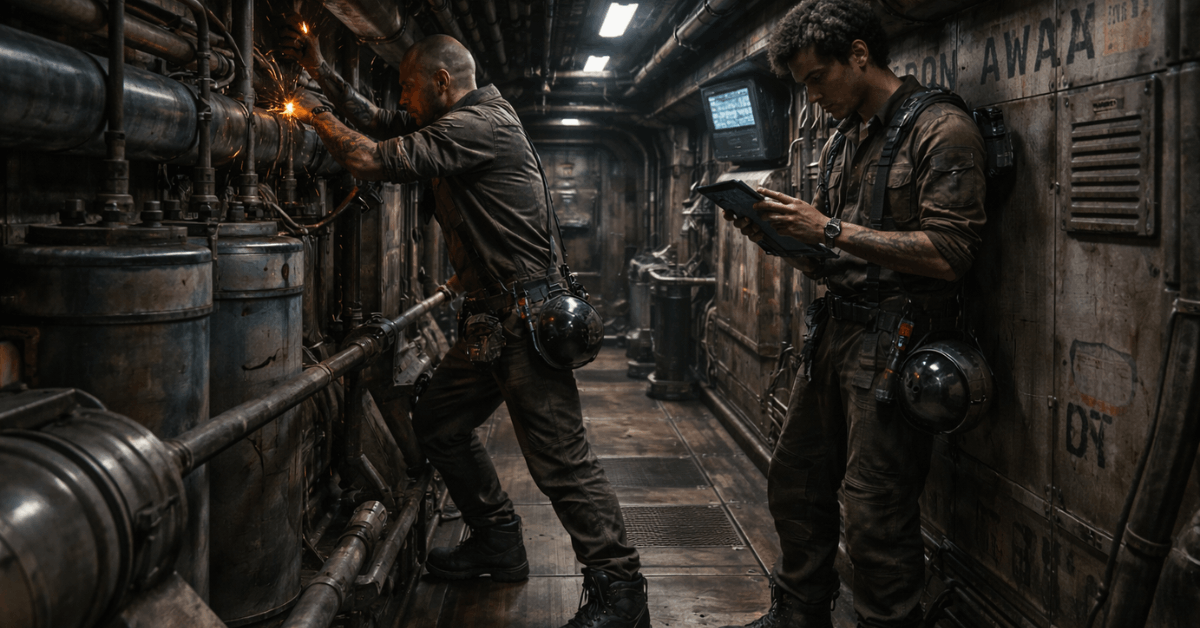
Ships accelerate to create gravity because there is no artificial gravity switch. Stations recycle air and water because resupply from Earth takes months, not hours.
Why Gravity as a Budget Changes Everything
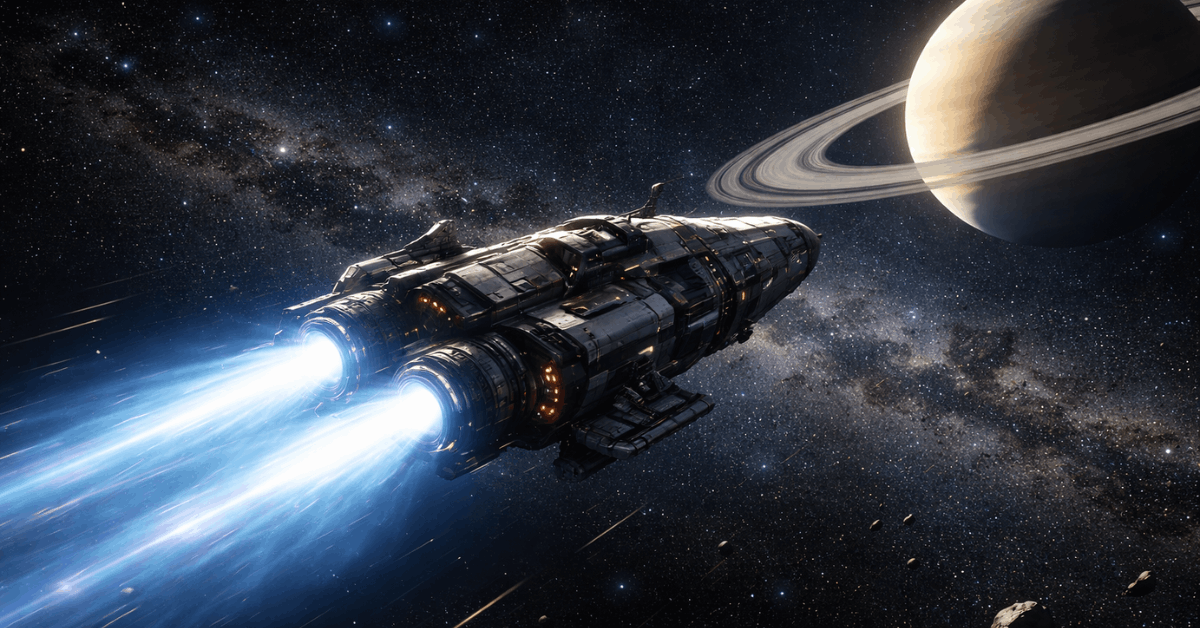
The Epstein Drive gives ships sustained thrust, and sustained thrust creates workable gravity. Simple enough.
But the moment a captain pushes too hard, biology enters the equation. G-loads hurt. Sometimes they kill.
I think the g-load mechanic, one of the first behavioral rules the series establishes in its opening scenes, does more narrative work than any other single technology.
Ordering a high-g burn means spending something real: crew health, blood pooling, potential casualties. That cost turns every tactical sprint into a meaningful decision.
Most science fiction hands out artificial gravity like a free side dish. The Expanse makes crews earn it. Artificial gravity becomes a budget that captains spend carefully, and that framing puts genuine weight behind every acceleration order.
How Logistics Drive Politics Without a Single Speech
Earth and Mars hold manufacturing capacity and military fleets. Belters hold position, labor, and the choke points that connect everything else. That asymmetry explains blockades, price squeezes, and security crackdowns without a character needing to narrate it aloud.
Supply lines decide who eats and who can move. Once that logic is established early, political conflict stops feeling like a writer’s device and starts feeling like an inevitable outcome of geography and scarcity.
Protest escalates because the most powerful leverage Belters hold is slowing cargo. Slow cargo invites a security response. Every character operating inside that system responds to incentives rather than following a script.
Culture as a Byproduct of Constraint
Belter Creole develops because stations are cut off from Earth’s linguistic drift across generations.
Gestures adapt to suit gloves. Memorial practices accept vacuum as a permanent ambient threat. None of this appears in a glossary. It shows up in behavior, which is the only place culture actually lives.
That is the gap most worldbuilders miss. They declare culture through exposition instead of encoding it in daily constraints.
Where Martian Culture Sometimes Flattens
Mars skews mission-oriented: terraforming timelines, military discipline, long-horizon planning. That reads clearly. But Martian society sometimes collapses into a single unified mood in a way that Belt stations and Earth cities do not.
I think the series underinvests in Martian subcultures, and the contrast makes the weakness visible.
A 200-year terraforming project would generate intense internal disagreements, generational splits, and competing ideological factions.
The series gestures at this without following through, which stands out precisely because the Belt and Earth carry so much more texture by comparison.
Also read: How to Read Succession Character Relationships Like a Power Map, Not a Family Tree
The Light-Speed Delay Is a Plot Engine, Not a Gimmick
Signals travel at light speed. A crisis at Jupiter reaches Earth after the outcome is already decided. News footage is old before it lands. Family messages arrive as artifacts of a moment that has passed.
That single constraint forces decentralization, traps leaders in permanent uncertainty, and regularly puts characters between bad options and worse ones.
I was genuinely surprised that this physics rule, specifically the Jupiter-to-Earth delay where crews sweat through quiet waits while Earth scrambles to catch up, generates more organic tension than most manufactured cliffhangers across the series.
Tension from physics rather than contrivance is a repeatable formula. The Expanse is one of the cleanest demonstrations of it in science fiction.
Where The Expanse Quietly Breaks Its Own Rules
Strong fundamentals create high expectations. The series earns enough trust that its missteps register as genuine failures rather than minor inconsistencies a reader shrugs past.
The Villain Churn Problem
Antagonists tend to exit within one book or season, which keeps momentum brisk and prevents overpowered threats from overstaying. Fresh threats then arrive claiming brilliance and organizational reach without much prior footprint in the setting.
Readers accept surprise when evidence leaks through earlier scenes: rumors of funding, doctrine shifts, networks operating quietly in the background.
Thin seeding makes talent feel conjured rather than earned. That dulls the hard-won realism the series spent chapters building.
Post-Conflict Tech Escalation and the Breadcrumb Problem
After a major crisis resolves, a multi-decade time jump arrives alongside a remote power and superior warships. New weapons overwhelm known counters overnight. Earlier doctrine becomes obsolete in a single reveal.
Escalation can refresh energy across a long series. But the series’ own standard requires breadcrumbs: prototype programs, doctrine debates, competing budget proposals from military factions.
Sparse setup makes advancements feel like a reset button rather than a natural evolution. The careful engineering tone that defined earlier arcs takes a real hit.
| Worldbuilding Element | Strength | Weakness |
|---|---|---|
| Propulsion and gravity | High-g burns carry genuine biological cost | Strongest consistent rule; rarely fails |
| Political conflict | Trade routes drive tension organically | Occasionally resolved without lasting consequence |
| Cultural texture | Belter behavior feels lived-in and earned | Martian subculture sometimes reads as monolithic |
| Antagonist buildup | Early villains are well-seeded and credible | Later entries arrive without established footprint |
| Tech escalation | Early weapons and limits are carefully defined | Post-jump technology arrives with sparse prior seeding |
Even the strongest worldbuilding systems show visible strain across a long timeline.
What Writers Can Take From This Series
The Expanse gets studied because its techniques transfer. Propulsion sets travel budgets. G-load limits set human ceilings.
Environmental controls make sabotage terrifying without constant gunfights. That is three story engines from one realistic physics decision, which is extraordinary efficiency.
Here is the honest worldbuilding checklist the series earns:
- Tie every major technology to a visible cost so characters must budget capability, not simply use it as a narrative convenience
- Let logistics drive conflict, because supply lines decide who eats, who moves, and who holds leverage over whom
- Encode culture in daily constraints and tools, not in declarations or glossary entries, so behavior feels earned rather than stamped on
- Seed future escalations through rumors, prototypes, and budget debates long before threats arrive fully formed and overwhelming
- Keep information delays active inside the plot, because lagged and incomplete data create power asymmetries that generate drama without manufactured conflict
One thing almost no breakdown of this series mentions: watch how it handles combat inside pressurized habitats.
Frangible rounds, choke-point strategies, and non-penetrating munitions appear because a hull breach kills by suffocation long before bullets finish the job. Security teams prefer sensors and lockdown protocols over firepower.
The widely accepted advice for worldbuilders is to make your fictional universe feel vast. I disagree with that completely. According to the novel series spanning nine books, the setting that earns the most reader trust is not the biggest one.
The most powerful worldbuilding move is making your world feel expensive.
Vast universes feel empty. Expensive universes feel real because every action carries a price, and every price creates a decision someone has to make.
A world where nothing costs anything produces nothing worth caring about.
Questions People Ask About The Expanse Worldbuilding
Q: Is the science in The Expanse actually accurate for a space opera? The series uses real orbital mechanics, light-speed communication delays, and biology-based g-load limits rather than hand-waving them for convenience. It is harder science fiction than most mainstream series, though the Epstein Drive itself remains fictional technology. The discipline is in treating physics as fixed rules rather than adjustable dials.
Q: Why do Belters speak differently from Earth and Mars characters? Belter Creole develops from generations of linguistic isolation across scattered stations, blending vocabulary from multiple Earth languages while adapting pronunciation and gesture to suit work in vacuum suits. It signals cultural identity and economic friction without exposition, which is exactly how dialect works in the real world.
Q: Why do The Expanse characters use frangible rounds inside stations? Standard bullets risk hull breaches in pressurized environments, which removes air, heat, and water control faster than any gunfight can be won. Frangible rounds break apart on impact rather than penetrating walls, keeping interior firefights lethal for people without turning them into habitat-ending events for everyone aboard.
Q: What makes antagonists in the later books feel less credible than early ones? Early villains have visible networks, prior reputations, and seeded evidence of their reach across earlier scenes. Later antagonists arrive with claims of organizational brilliance without that footprint inside the setting’s existing rumor mill. The problem is not the characters themselves but the absence of breadcrumbs that would make their capabilities feel earned.
Q: How does the light-speed delay affect political storytelling in the series? Leaders on Earth make decisions based on information that is already hours or days old, depending on where a crisis occurs. Crews in distant locations act without knowing how Earth or Mars has responded. That structural lag forces every political arc to account for imperfect timing, which removes easy resolution and keeps tension alive across long plot threads.
Conclusion
The Expanse earns its reputation not through spectacle but through consistent rules that make every choice feel consequential and real.
Every technology carries a price, every political conflict routes through logistics, and every culture adapts to physical constraints over time.
The series stumbles when shortcuts replace seeding and when social complexity collapses into one-note depictions. Apply its discipline to your own fictional world, and your readers will believe before you ever ask them to scale that belief further.