In a small German town, disappearances expose a time knot that binds four families across generations. A clear question opens the door, then the scale widens into fate, causality, and grief.
Readers searching for a Dark complete story recap need a straight timeline, plain definitions, and a precise ending walkthrough. This guide lays out the structure, the forces at play, and how the finale resolves the loop.
Quick Summary Of The Dark Complete Story
In Winden, missing children trigger an investigation that quietly becomes a time-travel mystery spanning three linked realities. Caves connect 1953, 1986, and 2019 in repeating 33-year cycles.
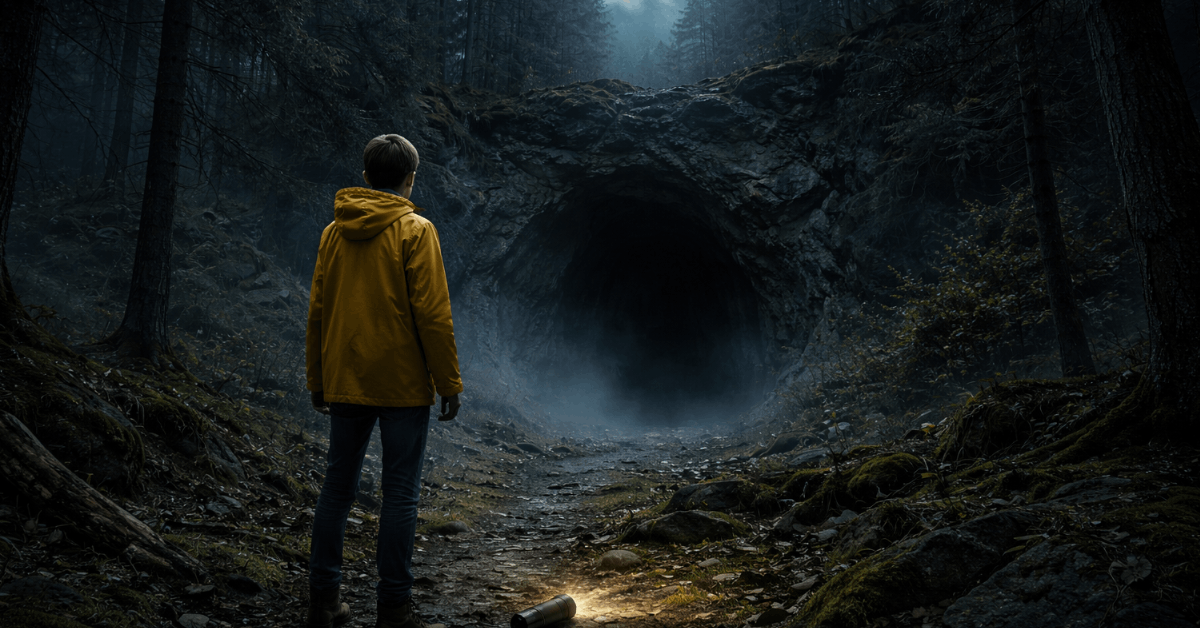
Travelers move events that already happened, creating bootstrap loops where effects become their own causes. Jonas Kahnwald learns that his older selves orchestrate and resist the same catastrophe. Martha Nielsen mirrors that journey across a second reality.
Origin World
In the background sits the Origin World, where clockmaker H. G. Tannhaus loses his son, daughter-in-law, and grandchild in 1971. Grief pushes him to build a device in 1986 that fractures reality.
Two knotted offshoots emerge, later known as Adam’s World and Eva’s World. Every paradox in the show grows out of that single failure. Claudia Tiedemann eventually maps the knot, finds the true source, and gives Jonas and Martha one actionable path.
The Finale
During the finale, Jonas and Martha travel through the rift at the 1986 explosion, reach the Origin World, and prevent the car crash that started Tannhaus’s obsession. Without the tragedy, he never builds the device. The two knotted worlds end, the loop dissolves, and a grounded Winden remains.
Timeline and Worlds In One View
A tight view helps anchor every reveal and flashback later.
- Adam’s World: The main setting across Seasons 1 and 2, home to Jonas, Ulrich, Katharina, and the four families.
- Eva’s World: A mirrored reality revealed at the end of Season 2, where Martha leads a faction preserving the knot.
- Origin World: The baseline reality where Tannhaus’s grief experiment occurs in 1986 after a 1971 family loss.
- Cycles And Rifts: A 33-year rhythm links 1953, 1986, and 2019, then 1920, 2052, and other nodes through machine travel.
- Apocalypses: Energy events in 2020 and 2019 freeze time briefly, enabling cross-reality intervention during the finale.
How The Mystery Starts: Missing Children To Time Loop
In the pilot, a group of teens heads toward the Winden caves and one boy does not return. Police procedures, family tensions, and rumor mills feel familiar at first, which keeps attention on character motives rather than jargon.
Clues pile up that cannot fit a single timeline, including items that appear older than they should and people who know things they should not.
The investigation cracks when a boy turns up in the past bearing modern marks. That moment reframes the case as a temporal riddle rather than a local crime.
Why The Plot Feels Complex Yet Coherent
In practice, the series limits breadth while deepening the same set of people across stages of life. Viewers meet roughly two dozen primary characters early, then revisit them as children, adults, and elders.
Scenes repeat in later episodes from new vantage points, revealing how older versions steered outcomes that once looked accidental.
Familiar beats return with new context, like the cave sequence with Mikkel or the apocalyptic corridor where Jonas sees Martha die. Complexity rises through layering, not through endless new subplots.
Key Forces and Goals: Adam, Eva, Claudia
Short clarity on the three leaders avoids confusion later.
- Adam: Older Jonas in Adam’s World who believes salvation requires destroying the knot and both offshoot worlds.
- Eva: Older Martha in Eva’s World who argues existence should persist, even with suffering baked into the loop.
- Claudia: The long-game strategist who maps ancestry and paradoxes across both offshoots, then targets the Origin World.
The Unknown and Bootstrap Mechanisms
The son of Jonas and Martha is presented as three ages acting in concert. That figure kills, sabotages, and safeguards events that must happen to preserve the knot.
Evidence of bootstrap loops sits everywhere, including devices that originate from themselves and family lines that only exist because of their own futures.
A simple frame helps keep it straight: if removing a person or object would erase the conditions that created it, the show is illustrating a bootstrap paradox. That is the engine of the knot, and a central reason the story resists simple fixes inside the offshoot worlds.
Free Will, Loops, and How Suspense Still Works
Because the loop keeps reasserting itself, outcomes often match what already happened. Suspense comes from missing steps rather than endpoints.
Viewers know Jonas survives long enough to become The Stranger, then Adam, yet do not know which betrayals and choices push him there. Other arcs pivot sharply, like Claudia’s move from measured executive to itinerant tactician.
Stakes attach to side goals as well, since parents, partners, and investigators pursue immediate objectives that spark damage elsewhere. The show treats agency as bounded: actions matter locally, yet still flow toward the same endpoints until the finale breaks the source.
Faith Echoes and The Rule Of Three
Religious names and ideas surface as thematic mirrors rather than sermons. Adam and Eva wage opposing campaigns that entangle desire, guilt, and rationalization. Noah serves a mission he only partially understands.
The Trinity appears as a structural motif:
- three worlds,
- three life stages, and a
- 33-year cadence.
Viewers track characters across childhood, adulthood, and elderhood while noticing continuity and divergence at once.
Those layers underline a running question about identity: do changing circumstances make a new person, or do they expose facets of the same person pulled forward in time?
The Ending, Step By Step
During the apocalyptic pause when time stalls, passageways open that do not normally exist. Claudia instructs Adam to steer his younger self toward cooperation rather than annihilation, because the knot’s cause lies outside both offshoots.
Jonas intercepts Martha, and together they ride the 1986 rift to the Origin World. That leg matters because standard travel would keep them inside the knot. In 1971, they stop Marek, Sonja, and the baby from crossing a broken bridge during a storm.
The family returns to Tannhaus alive. Grief never calcifies into obsession. The 1986 experiment does not occur. Adam’s World and Eva’s World wink out.
Grounded Dinner
In the coda, a grounded dinner in Winden shows a smaller circle of residents whose lives are no longer bound to the knot.
A pregnancy name choice nods to what once existed without recreating it. Emotional residue remains, which tells a quieter truth: shared memory and changed behavior outlast erased timelines in ways that still matter to people who remain.
Apparent Paradoxes and What The Show Implies
Questions about grandfather paradoxes surface quickly once the finale rewires cause and effect.
The show leans on two ideas rather than physics lectures. First, quantum entanglement as a narrative device lets multiple paths coexist until a higher-level intervention collapses them.
Second, the Origin World sits outside that superposition within the story’s rules, so saving the family in 1971 ends the conditions that required the knot without creating a visible fork there. Viewers who prefer airtight logic will still find edges to probe, yet the internal intent is clear: the knot can only be ended where it began.
Character Arcs: Grief, Empathy, and Perspective
Aging characters gain self-awareness that shifts their choices, even when outcomes initially look fixed. Helge tries to stop earlier harm. Egon learns hard truths that reframe his prior judgments. Claudia’s remorse fuels the map that finally matters.
Empathy expands as hindsight grows, which is why later versions attempt repair even when repair seems impossible. Jonas and Martha form the exception, hardening across cycles as their bodies and beliefs calcify through repeated exposure to catastrophe.
The finale forces that pair to choose release over control. That decision ends their branches and removes the machinery that kept causing harm.
How To Track Families Without Getting Lost
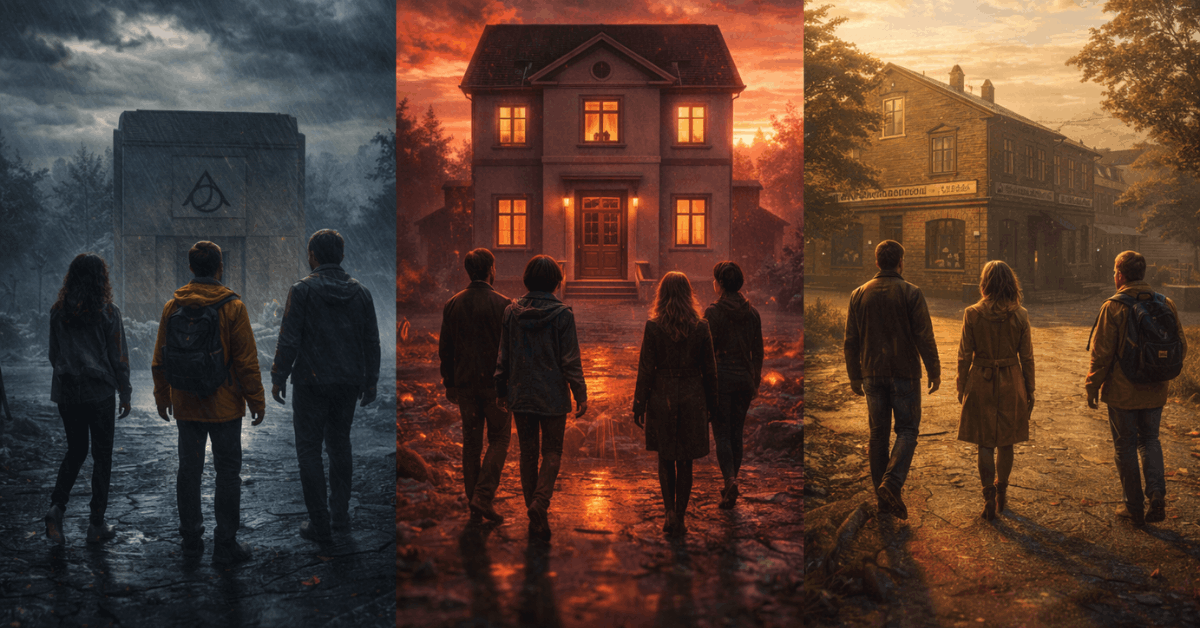
In most rewatches, clarity improves when family links come first. Start with the Kahnwalds, Nielsens, Tiedemanns, and Dopplers in the 2019 layer, then pin their 1986 and 1953 counterparts.
Add adoptees and non-biological ties afterward. Keep an index of maiden names, which resolves apparent disconnects during older scenes. A pen-and-paper grid remains the fastest way to stabilize identities across worlds.
Anyone building a Dark family tree should mark the Origin World residents separately so the finale’s dinner scene makes immediate sense.
What Viewers Should Take Away
Tragedy originates in a single household, spreads through grief-fueled invention, and echoes across generations. Attempts to bend time for comfort burn entire lives instead.
Letting go achieves what control cannot. The final image rejects destiny theater and centers ordinary peace. That landing does not hand every viewer a tidy theorem, yet it does honor the story’s central stakes: families, memory, and the cost of refusing loss.