In the Stranger Things Ending, the story closes where it began, around a table and a Dungeons & Dragons campaign.
Final risks feel larger, monsters feel meaner, and choices finally stick. Stakes expand across Hawkins, Camazotz, and the Abyss, yet resolution returns to small human decisions that defined the series.
Expect closure across character arcs, a readable point of view on Vecna and the Mind Flayer, and an ending that keeps one mystery alive.
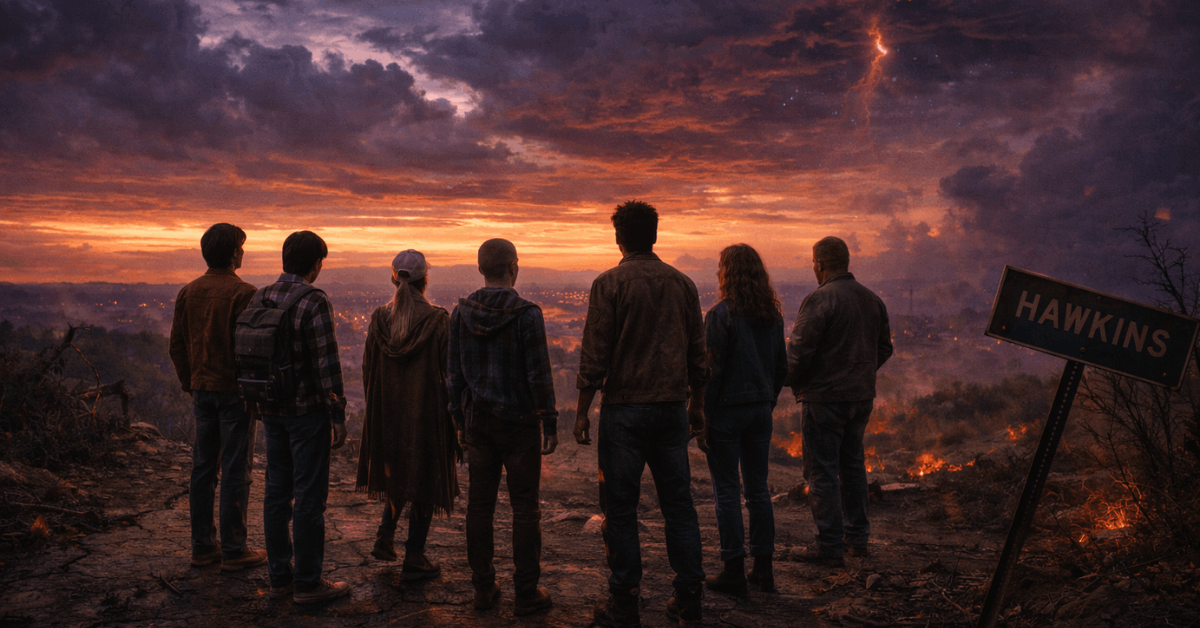
How The Final Fight Actually Plays Out
Final confrontations unfold across two fronts, with psychic combat running in parallel to practical sabotage. Each crew contributes a specific skill, echoing the tabletop DNA that shaped the friend group.
Strategy matters because the monsters only fall when multiple actions land in sequence. Expect brisk cutting between locations, then a longer exhale after the killing blow.
Camazotz and The Abyss
Eleven, Kali, and Max attack Henry in his mind, halting the merge between the Abyss and Earth.
That strike buys time for the Hawkins team to climb the Squawk radio tower and drop into the Abyss, where the Pain Tree reveals itself as the Mind Flayer. Eleven fights inside the creature’s body while the ground team staggers it through coordinated hits.
Hawkins and The Bomb
Hopper and Murray set a timed bomb inside the Upside Down, keyed to Prince’s Purple Rain album. The plan mirrors a war-movie bridge demolition, aiming to collapse the wormhole once the monsters fall.
Timing proves tight, so the team commits to a one-way run if necessary, trusting the final sequence to hold.
Was Vecna Controlling The Mind Flayer Or Vice Versa
Motivation sits at the center of the finale’s thesis. Will argues the Mind Flayer used Henry, repeating the path it tried on him.
Henry rejects that frame, claiming agency and ideology, insisting that the Mind Flayer revealed the world’s rot rather than puppeteered him. Writers leave a sliver of ambiguity for viewers, yet the plot treats Henry’s allegiance as his own decision, not a possession he could not resist.
Who Ultimately Kills Vecna
Momentum swings toward Henry until Will breaks his focus and Eleven drives him onto a spire. The killing stroke belongs to Joyce, who beheads Vecna and ends the threat outright.
That choice tracks the series’ moral memory, since Joyce first believed when nobody else did and forced Hawkins to face the truth.
Line delivery lands hard, the language spikes, and the show finally spends its single intentional f-bomb on a moment that earns it. Joyce kills Vecna becomes the canon answer to a question fans debated for years.
What Happens To The Upside Down
Detonations ripple through the interdimensional bridge as Purple Rain hits its final track. Tunnels collapse, spores evaporate, and gateways seal as the wormhole folds.
Inspiration nods to The Bridge on the River Kwai, swapped into a supernatural key where a site rather than a span must fall.
The series treats the breach as infrastructure, so destroying it ends recurring escalation rather than pausing it. The Upside Down destroyed reading fits the visual language and the characters’ relief.
Does Eleven Die Or Survive
Self-sacrifice sits at the heart of Eleven’s final choice. After the timer starts, the team sprints for MAC-Z while she stays in the collapsing dimension.
A short goodbye inside the void gives Mike a final image that doubles as a challenge, believe in an escape or accept a heroic death.
Later, the D&D table hears Mike’s hopeful tale about a last illusion from Kali, a route that lets Jane disappear into a quiet village. The show refuses to close that loop, which sustains the Eleven sacrifice theory many viewers adopt while still offering comfort to the party.
The Scientist’s Briefcase and Henry’s Worst Memory
Episode revelations drop the missing piece into Henry’s timeline. After bludgeoning a scientist in the Nevada desert, young Henry opens a briefcase and finds a rock seeded with Mind Flayer particles.
Possession follows the contact, inviting him to “come find me” and binding his future to the entity. Fear of the cave memory flows from that formative loss, since it cost his childhood and shaped everything that followed. The Henry Creel backstory gains texture without softening accountability.
The Pain Tree, The Canyon, and Team Tactics
Action sequences reward attention to earlier seasons’ tools. Nancy lures the Mind Flayer toward a canyon while Jonathan and Robin attack from above, using height to burn the outer surface. Lucas launches accelerant balloons with his wrist rocket, and Mike lights them with a flare gun.
Dustin and Steve stab egg sacks from beneath to interrupt regeneration. Coordination wins the Vecna final battle, not a lone power spike, which reinforces the series’ thesis on friendship and combined skill checks.
Who Lives and Who Dies: Quick Roll Call
Short context helps track fallout during the chaos-heavy middle stretch. Expect a few shocks and a firm outcome on the main threat.
- Hopper wipes out multiple Wolf Pack soldiers during a rescue push at Hawkins Lab inside the Upside Down.
- Lieutenant Akers shoots Kali after Hopper refuses to give up Eleven’s location, triggering Eleven’s counterattack.
- Eleven forces the remaining Wolf Pack to fall, then compels Akers to turn his weapon on himself.
- Vecna falls to a combined effort, followed by Joyce’s beheading strike that ends the immediate danger.
- Core teens and parents survive the final sequence, setting up epilogue beats across cities and schools.
Where The Party Ends Up After Graduation
Character epilogues land in a clean sequence that honors earlier growth. Each outcome feels specific rather than generic, which strengthens the farewell.
- Max and Lucas finally get their movie date and later build a life together.
- Dustin enrolls at a university and still finds time for adventures with Steve.
- Will finds acceptance in a bigger city, teased through a quiet bar conversation.
- Mike embraces storytelling and becomes a writer, aligning talent to direction.
- The Dungeons & Dragons epilogue passes the torch to younger kids, signaling an end to childhood.
Nancy, Jonathan, Steve, and Robin
Paths diverge while friendships hold. Robin attends Smith College in Massachusetts, Nancy drops out of Emerson to join the Boston Herald, and Jonathan studies film at New York University while working on an anti-capitalist cannibal project.
Steve stays in Hawkins, coaches little-league baseball, and mentors kids, which suits his protective instincts and steady patience. Monthly meetups at Robin’s uncle’s place in Philadelphia keep the bond alive without forcing romance where the arcs refused it.
Hopper and Joyce
Resolution arrives without hedging. A date at Enzo’s finally happens, the proposal lands, and plans take shape for a move to Montauk, New York.
Hopper has a job waiting as chief of police, a grounded endpoint that trades constant crisis for meaningful work. Domestic stability reads as earned rather than easy, since both characters carried grief, distance, and risk across five seasons.
Ted Wheeler and Other Loose Ends
Ted survives injuries from the Demogorgon attack in Episode 2 and returns at Mike’s graduation.
The coda offers quick checks on parents and side characters without overplaying the beats. Those passes keep the focus on the party and the world they shaped, which keeps momentum moving toward the basement farewell.
Finale Music and Meaning
Credits roll over David Bowie’s Heroes after the show reuses the Season 1 cue that once accompanied a body pullout fakeout, originally performed as a Peter Gabriel cover.
Joe Keery reportedly suggested switching to Bowie’s original for the last minutes, which reframes the series as an anthem for ordinary bravery. The Finale song Heroes placement ties back to the start while claiming the ending as earned rather than nostalgic.
Themes That Explain The Ending
Closure rises from three ideas that the finale underlines repeatedly. First, every victory requires shared action, so the series rewards teamwork over solo heroics. Second, growth brings endings, which is why the basement walkout feels heavy yet right.
Third, power without values mutates into ideology, a frame that clarifies Henry’s insistence that he chose his path. Those threads make the Stranger Things Ending feel coherent even when pacing stretches or epilogue stacking runs long.
What The Ending Says About Villainy
Villains in Stranger Things collect pain, then rationalize control, so audiences watch a human slide rather than a mask removal. Henry’s cave memory matters because it marks a point of contact, not a removal of agency.
Accepting the Mind Flayer’s offer makes him responsible for outcomes, which sidesteps the safest redemption arc while avoiding a puppet excuse. That stance keeps the finale honest about choice and consequence.
Why The Final Scene Works
Back-to-basement framing validates the storytelling engine that powered the series. Friends gather, roll dice, and imagine solutions together, which mirrors how they survive every season.
A handoff to younger kids closes the loop by acknowledging time, not defeating it. Audience investment finds release in small gestures, shared looks, and a final ascent from childhood that feels both inevitable and earned.
Fair Critiques That Still Leave A Strong Aftertaste
Pacing wobbles during the last forty-five minutes, stacking multiple epilogues that could have been compressed. Military subplot beats occasionally drag, even though Eleven’s ultimate decision connects cleanly to that pressure.
Another ten minutes of Vecna screen time would have sharpened menace and let Jamie Campbell Bower’s performance breathe longer. Those notes do not undercut the core achievement, since character payoffs land, action reads clearly, and closure arrives without cheats.
Final Verdict
Ending quality depends on emotional truth more than surprise, and this finale honors that rule. Monsters fall because every friend contributes, families heal because someone finally believes, and childhood ends because it must.
Ambiguity around Eleven keeps a light on in the distance without reopening the door to new gates. As a whole, the Stranger Things Ending delivers spectacle, consequence, and a human-scale goodbye that respects the journey.