In fast-moving stories, clarity comes from pinning events to dates and cause to effect. The Witcher timeline spans millennia, folds in prophecy, and jumps across eras without apology.
The guide here is practical: track what happens first, what follows, and how each beat shapes Geralt, Yennefer, and Ciri. Expect a clean chronological map anchored to on-screen canon and official recaps, minus spoilers beyond aired material.
How To Read The Witcher Timeline
Clear chronology helps connect character arcs, political shifts, and supernatural triggers. This guide places headline events in order, highlights decisive years, and flags where seasons compress or expand time.
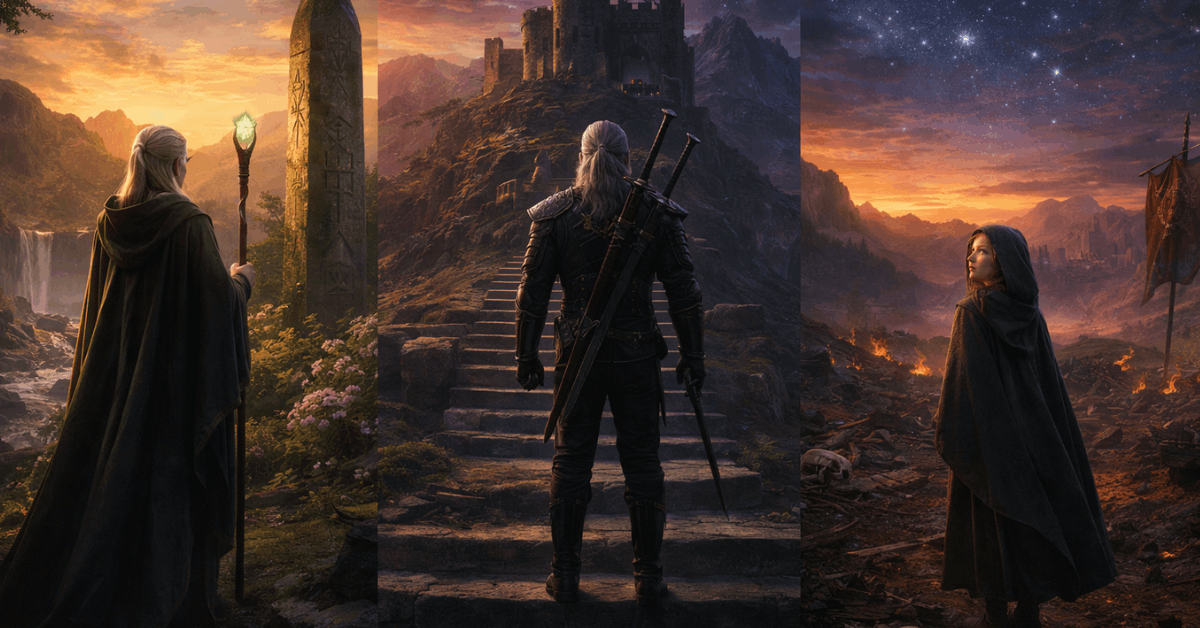
Timeline anchors use widely referenced dates and descriptors seen across Netflix productions and official explainers. In tricky spans, brief notes indicate context needed to keep scenes straight.
Ancient Eras Before Humans
Long before humans, dwarves held much of what later became Pryshia, Darwen, and Xin’trea, leaving scripts, steelwork, and monolith ties that matter centuries later.
Elven hero Solryth drove the dwarves east and led elfkind into a Golden Age of cities, trade, higher education, and earth magic.
After Solryth’s death, three elven kingdoms fractured into a thousand-year conflict that normalized siege, famine, and coup attempts. Blood Origin events culminate in a palace-spanning plot that topples monarchies and sets tinder around the Continent’s most dangerous artifacts.
Year 0000: The Conjunction Of The Spheres Explained
During a coordinated strike, Chief Sage Balor exploits stolen portal equations and weaponized monsters, while a seven-person warband pushes back and targets a master monolith.
The effort shreds veils between worlds, an event known as the Conjunction of the Spheres explained in-universe as dimensions briefly overlapping and depositing humans and monsters onto the Continent.
Fjall endures the first prototype witcher transformation to counter Balor’s hydra, Eredin is cast off-world toward the future Wild Hunt, and Ithlinne’s prophecy sets a generational fuse that will converge on Ciri. Avallac’h’s early time-travel studies foreshadow later cross-era entanglements.
Foundations Of Magic and Early Institutions
A few milestones establish long-running power centers and norms that govern sorcery, training, and monster hunting. Treat the entries below as baseline context when later seasons reference “the Brotherhood,” “Aretuza,” or “first witchers.”
| Pillar | Year | What It Sets In Motion |
| Laws Of Magic Drafted | Shortly After Conjunction | Codifies Chaos use and political bounds under early Brotherhood oversight. |
| Brotherhood Of Sorcerers Founded | Early Post-Conjunction | Centralizes mage influence across northern courts and wars. |
| Aretuza Academy Opens | Early Post-Conjunction | Trains apprentices who later advise rulers, police rogue magic, and fight in wars. |
| First Witcher Created | 967 | Establishes mutated monster hunters as a profession matched to frontier threats. |
| Kaer Morhen Sacked | 1165 | Forces an era of decline; surviving witchers become a dwindling order. |
Vesemir and The Fall Of Most Witchers
Several decades before Geralt, Vesemir passes through Kaer Morhen’s brutal trials, then chases coin as monsters wane and towns sour on witchers.
Evidence of manufactured monsters collapses local trust, and a coordinated assault destroys the keep, kills most witchers, and erases the mutagen formula.
Kaer Morhen history explains why later winters show only a handful of veterans and why training new recruits borders on impossible.
Key Births, Curses, and Reigns Leading To Cintra’s Fall
Across the twelfth and thirteenth centuries, precise dates anchor character origins and political shifts.
Geralt is born in 1160 and later left to the witchers; Yennefer is born in 1192 and sent to Aretuza in 1206; Calanthe, born 1216, ascends in 1230 and earns the “Lioness of Cintra” moniker after Hochebuz.
Stregobor’s eclipse theory brands Renfri as cursed in 1212, while the Temerian striga curse traces to 1229 and is lifted years later by Geralt. The Nilfgaard invasion timeline picks up momentum in 1239 as the empire pushes north and tests northern defenses ahead of the Cintran catastrophe.
Cintra Falls and Sodden Hill: Five Date Anchors
Major beats in this era concentrate the fates of Geralt, Yennefer, and Ciri, then reset the political board. The snapshots below keep pivotal events aligned for rewatching or recap checks.
| Event | Year | Why It Matters |
| The Butcher Of Blaviken | 1231 | Geralt’s refusal to choose a lesser evil sets a lasting reputation marker. |
| Law Of Surprise Claimed; Double Wedding | 1249 | Geralt ties destiny to Pavetta and Duny, linking him to an unborn Ciri. |
| Birth Of Ciri | 1250 | Elder Blood prophecy shifts from abstract to living heir in Cintra. |
| Slaughter Of Cintra | 1263 | Nilfgaard breaches the city; Ciri flees; Calanthe falls with the kingdom. |
| Battle Of Sodden Hill | 1264 | Mages halt Nilfgaard’s first major push at great cost; Yennefer disappears. |
Geralt’s Early Journeys and Yennefer’s Arc, In Order
During the 1206–1262 span, the show’s first season hops between threads that are easy to flatten once dated.
Yennefer trains, undergoes transformation in 1210, and enters court service while struggling with the cost of power and infertility. Geralt meets Jaskier in 1240, lifts the Temerian striga curse in 1243, and binds fates with Yennefer after the djinn in 1256.
A dragon hunt in 1262 reveals that feelings may be entangled with a wish, not pure choice, which complicates their future decisions when war accelerates.
The Witcher and Ciri Timeline After Cintra
After the 1263 sack, Geralt and Ciri finally meet near Sodden as refugees scatter and realms brace for another front. In 1265, their path to Kaer Morhen puts training, discipline, and monster logic against Ciri’s visions, monolith echoes, and surging power.
Voleth Meir’s manipulations trigger deaths among witchers and a crisis that forces combined mage-witcher action to expel the entity.
Across the same span, Yennefer and Fringilla are pulled into elf-Nilfgaard alliances, and a devastating elven-infant murder later traces to Emhyr, who reveals himself in 1266 as Duny, Ciri’s father. Elder Blood prophecy becomes less academic when Ciri’s sphere-walking potential draws monsters and factions like iron draws lodestones.
Season Three Alignments and The Conclave
Roughly six months after the Kaer Morhen winter, Geralt, Yennefer, and Ciri move between safe houses while hunting leaks inside the Brotherhood.
Initial evidence implicates Stregobor, yet the deeper rot points to Vilgefortz as Nilfgaard’s true ally.
Court politics, mage power consolidation, and emperor-level ambitions converge around a single objective: control the child of the Elder Blood. Stakes escalate because every faction believes Ciri’s choice will determine who writes the next chapter of The Witcher chronology, not merely who wins the next battle.
Viewing Order Tips For Confusing Jumps
Short prep reduces whiplash when seasons compress decades into episodes or parallel arcs. Keep these checks handy when scenes move fast and years flash briefly.
- Track hairstyles, armor crests, and court lineups to infer whether a scene falls pre- or post-Cintra.
- Map Yennefer’s status by power access: apprentice, court mage, fire-magic cost, then recovery stretches.
- Anchor Geralt’s reputation beats to Blaviken first, then the dragon hunt, then Sodden aftermath.
- Treat Ciri’s surroundings as signals: castle, road, camp, Brokilon, Kaer Morhen, then broader spheres.
- Pair Nilfgaard’s banners and commanders to invasion waves to keep political subplots coherent.
Where Myths, Politics, and Mutation Converge
Across centuries, three forces keep resetting the board: cosmic disorder, imperial ambition, and engineered monster hunters.
The Conjunction created the conditions for mages and monsters; empires like Nilfgaard exploited the gaps; witchers emerged as a practical answer that societies later tried to discard.
Geralt’s trade survives because frontier villages still face threats courts ignore, while Ciri’s ability to traverse space and time links present risk to ancient cause. For viewers wanting clean continuity, the sequence above threads character choices through fixed dates so season edits feel deliberate, not disorienting.
Quick Reference: Core Arcs and What To Note
Short summaries lock dates to arcs for faster recall during rewatches or recap writing.
- Elven Golden Age To Coup: Dwarven retreat, Solryth’s legacy, three elven kingdoms, and a coup paving the path to the Conjunction.
- Conjunction To Codification: Dimensional overlap, humans and monsters arrive, Laws of Magic drafted, Aretuza established, first witchers created.
- Rise And Ruin Of Witchers: Kaer Morhen thrives, then falls; mutagen knowledge largely lost; Vesemir mentors the last generation.
- Seeds Of Destiny: Law of Surprise links Geralt to Ciri; Elder Blood prophecy reenters politics through Cintra’s line.
- Wars And Aftermath: Cintra’s fall in 1263, Sodden in 1264, shifting alliances, and Emhyr’s reveal tightening the net around Ciri.
Why The Story Jumps Around
Nonlinear structure heightens mystery, pays off rewatching, and lets writers juxtapose outcomes with their origins. Characters cross decades emotionally before they meet physically, which turns a prophecy into an engine rather than a footnote.
Timeline discipline still holds: when dates are known, arcs line up; when years blur, anchors above restore order fast for anyone tracking continuity during eager binge sessions.